Starting over with a new starter
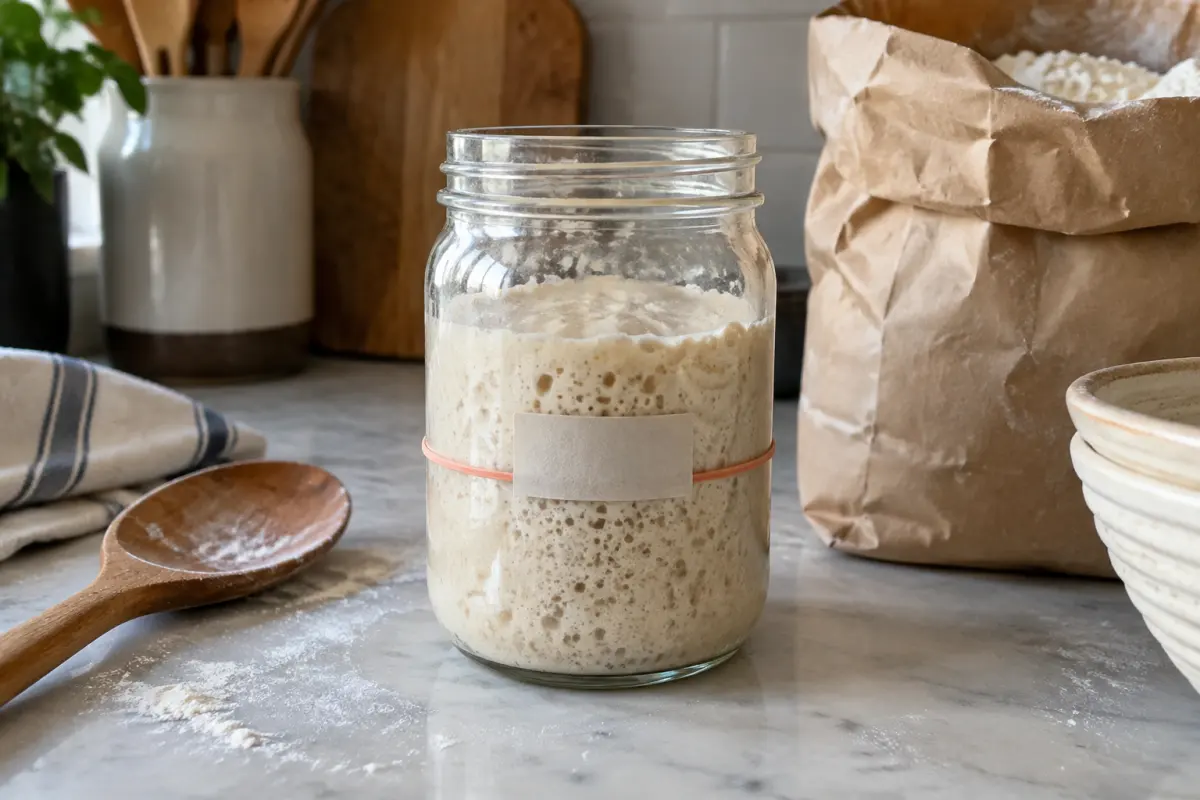
The old jar gave up some time in February. I had been feeding it once a week, which is roughly the attention a houseplant gets in this house, and one morning it smelled of nail polish rather than apples. There is a point past which you can revive a starter and a point past which you are just being stubborn. I threw it out.
So: a new one. Fifty grams of wholegrain rye, fifty grams of water at whatever temperature the tap gives in March, a jar, a rubber band to mark the level. The shelf above the radiator sits at about 24 °C, which is warm enough to make things happen without making them happen too fast.
The whole thing
- Day 1: 50 g wholegrain rye, 50 g water. Stir, cover loosely.
- Days 2–4: discard all but 30 g, add 30 g rye, 30 g water. Once a day.
- Days 5 onward: same, twice a day, switching to half rye, half white.
- Ready when it doubles in four to five hours and smells like yoghurt.
Day two is the famous false start. It bubbled enthusiastically, rose nearly to the band, and smelled vaguely of cheese. That is not yeast doing the work yet, it is bacteria having a brief party before the pH drops. Day three it went flat and sulky, which is exactly as it should be. The trick is to keep feeding through the sulky part.
By day six it was doubling in five hours. By day nine, four. I baked with it on day eleven and the loaf was fine. Not good: fine. A young starter makes a loaf with a slightly tight crumb and a flavour that has not decided what it wants to be. That takes a couple of months.
The rubber band is the only piece of equipment here that really matters. Without it you will swear the starter is not rising, because you cannot see a change you did not mark.